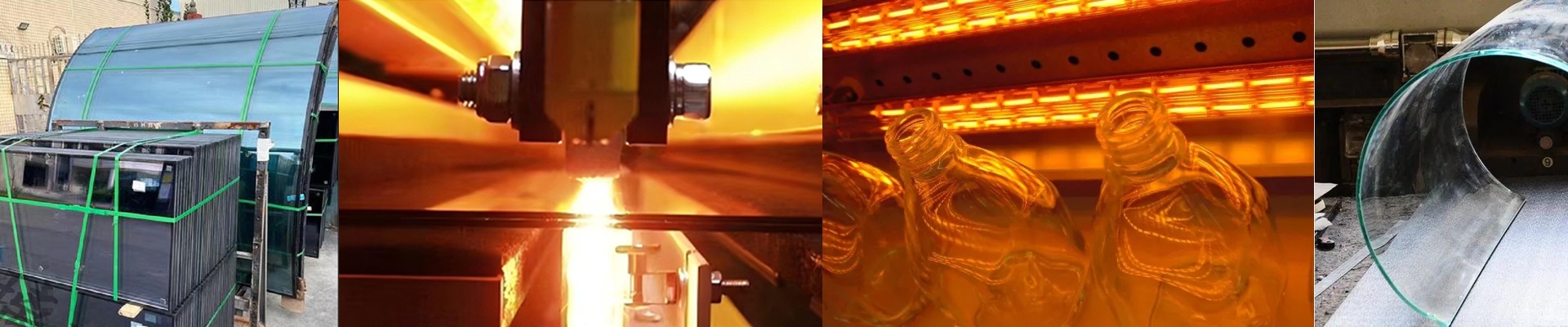
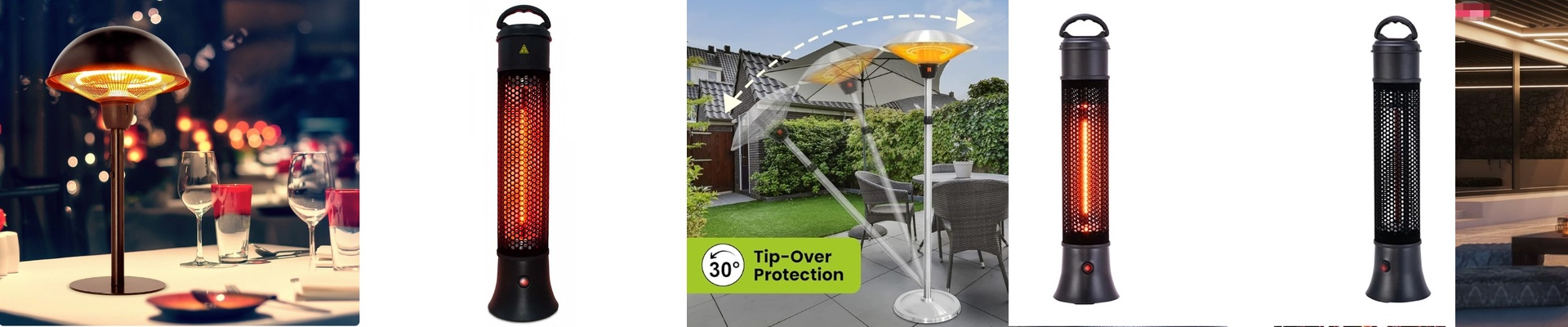

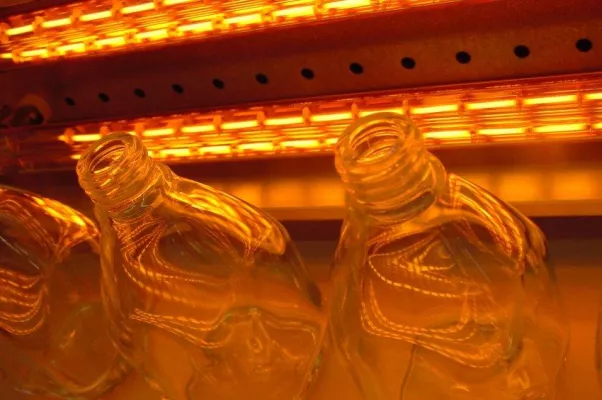
On the bending line, minutes are money. Every extra minute spent heating the mold or waiting for temperature stability is a minute your press isn’t running. And every scrap that shows up late is material, labor, and energy you can’t claw back. The bending cycle is the heartbeat of the line. When it’s slow or unstable, the whole shop feels it—missed targets, rework, and overtime. We build heating systems for glass bending that cut cycle time without making the thermal field jump around. The point isn’t just faster heat-up. It’s repeatable temperature distribution, predictable glass behavior, and fewer stops to tweak.
What matters, technically
Glass bending is a thermal game, and thermal control is what separates a line that runs from one that hunts. We run short-wave infrared quartz heaters in modular arrays. Quartz gives you rapid response with high power density, so the heat is there when the cycle needs it and off when it doesn’t. The wavelength is tuned for fast energy transfer into the mold and glass, which tightens the control loop. That matters when you’re chasing seconds. None of these specs are arbitrary. They’re chosen to match the reality of the bending line:
- Fast response time: Quartz IR elements hit operating temperature quickly, so the heating phase starts right away. In practice, that shaves tens of seconds off each cycle compared with slower, convection-heavy systems.
- Targeted spectral output: Short-wave IR aligns with the absorption profile of glass and typical mold materials, improving heat transfer efficiency and cutting wasted energy.
- Zoned power control: Multiple independent heating zones let you shape the thermal profile across the bending mold. That reduces hot and cold spots that cause uneven sag and inconsistent bend geometry.
- High-temperature stability: Quartz elements hold output under thermal cycling, so the heating curve doesn’t drift shift to shift.
- Industrial power and connections: Configured for 3-phase supply and standard industrial connectors, the module integrates into existing control panels and machine interfaces with minimal rework. Numbers only matter if they translate into stable cycles. We design the heater layout, reflector geometry, and control strategy so the thermal field is uniform enough to prevent local hot zones that drive thermal stress and breakage.
Why this works on the floor
On a bending line, cycle time is the sum of a lot of small decisions—how fast the mold heats, how evenly the glass heats, and how quickly the system recovers after each cycle. A slow or uneven heat source forces you to pad the timing to cover variability. That padding adds up. With optimized heating, you get shorter, repeatable cycles. The press spends less time waiting and more time producing. In practice, lines see cycle reductions that translate directly into higher throughput without adding shifts. Quality is the other half. Bending is forgiving only when temperature is uniform. Uneven heating shows up as inconsistent curvature, optical distortion, and edge defects. It also shows up as scrap late in the process, after the glass has been cut and shaped. Predictable heating reduces those failure modes because the glass sees the same thermal history every time. Energy use drops as a byproduct. Shorter heat-on time and better coupling mean less electricity per bent piece. When you run thousands of parts per shift, the savings are measurable on the utility bill and on the plant’s peak demand. Safety and uptime are baked into the approach. Fast, controlled heating means less idling at high temperature, which reduces thermal stress on components and lowers the risk of runaway conditions. The modules are built for the shop floor—stable under repeated thermal shock, and compatible with the harsh environment around bending presses. This isn’t theory. It’s the difference between a line that meets its schedule and one that chases it.
The details you need to get right
Shortening the bending cycle isn’t just swapping heaters. It’s matching the heating system to the machine and the process.
- Control integration: The heater array has to play nicely with your machine controller and thermocouple strategy. If the control loop is too slow, the thermal response lags and the cycle gains disappear. Plan the interface work up front.
- Thermal layout: Zone power and heater placement have to align with the mold geometry. A mismatched layout can create edge-to-center gradients that show up as shape variation. We size zones and position heaters based on the mold, not a catalog.
- Electrical infrastructure: High-density heating demands clean, stable power. Verify local supply capacity and protection settings. If your plant runs near peak demand, phase balancing matters.
- Maintenance access: Quartz elements and reflectors need inspection. Mount them so you can check alignment and cleanliness during scheduled stops, not during unplanned downtime. Here’s the trade-off to be straight about: faster cycles mean thermal shock hits the mold and fixtures more often. Pair the heating upgrade with a disciplined preventive maintenance schedule, and use mold materials and coatings suited for rapid cycling. The payoff is worth it—but only if you plan for the wear. If your bending line is living with long cycles, inconsistent shape, or too much scrap, the bottleneck is likely thermal. We focus on the heating system so you can focus on throughput, quality, and safety. The cycle time you save is the capacity you gain.