
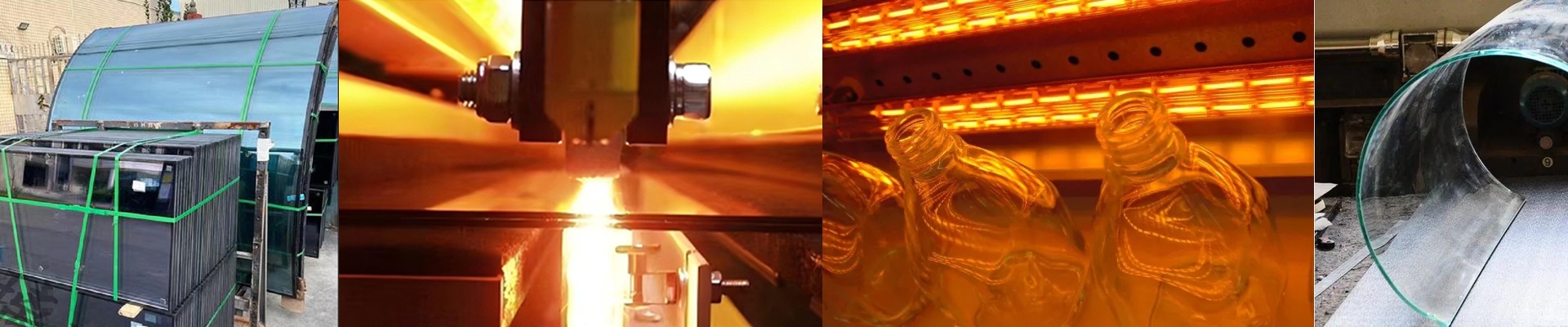
On the glass floor, heat is the lever that makes or breaks yield. When the thermal profile starts to drift, you see it everywhere—optical distortion in bending, stress marks in tempering, and weak edges in lamination. We built our CE-approved infrared lamps to stop that drift where it starts. What matters, technically These NIR lamps use short-wave infrared emitters in a quartz envelope, so response is fast and power density is high without a lot of convection. The spectral output concentrates energy where glass absorbs well, which shortens soak time and trims overall cycle time. Rated for 230/400 V, with ceramic mounts and standardized terminals, the modules drop into existing fixtures and can be zoned to build repeatable, uniform thermal fields. Control is PID with SSR interfaces, so you can lock setpoints and keep glass temperature in a tight band. Here is why that matters on the line. In tempering, the lamps hit the surface fast, giving you the steep thermal gradient needed for consistent compression without cooking the core. In bending, they lay heat evenly across complex shapes, which cuts down on sag and keeps thermal stress cracks from showing up. For coating drying, they drive solvents out uniformly, so you get less haze and fewer pinholes. In EVA/SGP/PVB lamination, they bring the stack up to the de-airing temperature quickly, then hold for a controlled cure—optical clarity holds, and edge bond strength improves. In insulating glass sealing, they preheat frames and desiccants consistently, so the secondary seal adhesion stays predictable. Installation is straightforward, but alignment matters. Reflectors need to be within 2 mm and kept clean; otherwise, uniformity goes sideways. The surface runs hot, so keep combustibles away, keep shielding in place, and make sure your line voltage and cooling air match the lamp ratings. With routine cleaning and stable power, the emitters run 5,000+ hours with minimal output drop.